
What Are Proanthocyanidins?
Proanthocyanidins (PAs) are natural polyphenol compounds widely found in plants such as grape seeds, pine bark, berries, cocoa, and apples.
As an important group of plant antioxidants, proanthocyanidins are widely used in:
- Dietary supplements
- Functional foods
- Beauty and cosmetic ingredients
- Botanical extracts
When purchasing grape seed extract or other proanthocyanidin-rich ingredients, buyers often focus on the content of Oligomeric Proanthocyanidins (OPC), because OPC represents the smaller and more bioavailable fraction of proanthocyanidins.
However, proanthocyanidins are not a single compound. They include different molecular structures depending on their degree of polymerization (DP).
Based on molecular size, proanthocyanidins are commonly divided into:
- Oligomeric Proanthocyanidins (OPC)
- Polymeric Proanthocyanidins (PPC)
How Are Proanthocyanidins Structured?
Proanthocyanidins are polymers mainly formed from flavan-3-ol units, including:
- Catechin
- Epicatechin
Depending on the plant source, some galloylated forms such as epicatechin gallate may also be present.
Degree of Polymerization (DP)
The degree of polymerization (DP) refers to the number of flavanol units connected in the molecular structure.
Different polymerization degrees result in different molecular sizes and biological properties.
OPC vs PPC: Classification by Polymerization Degree
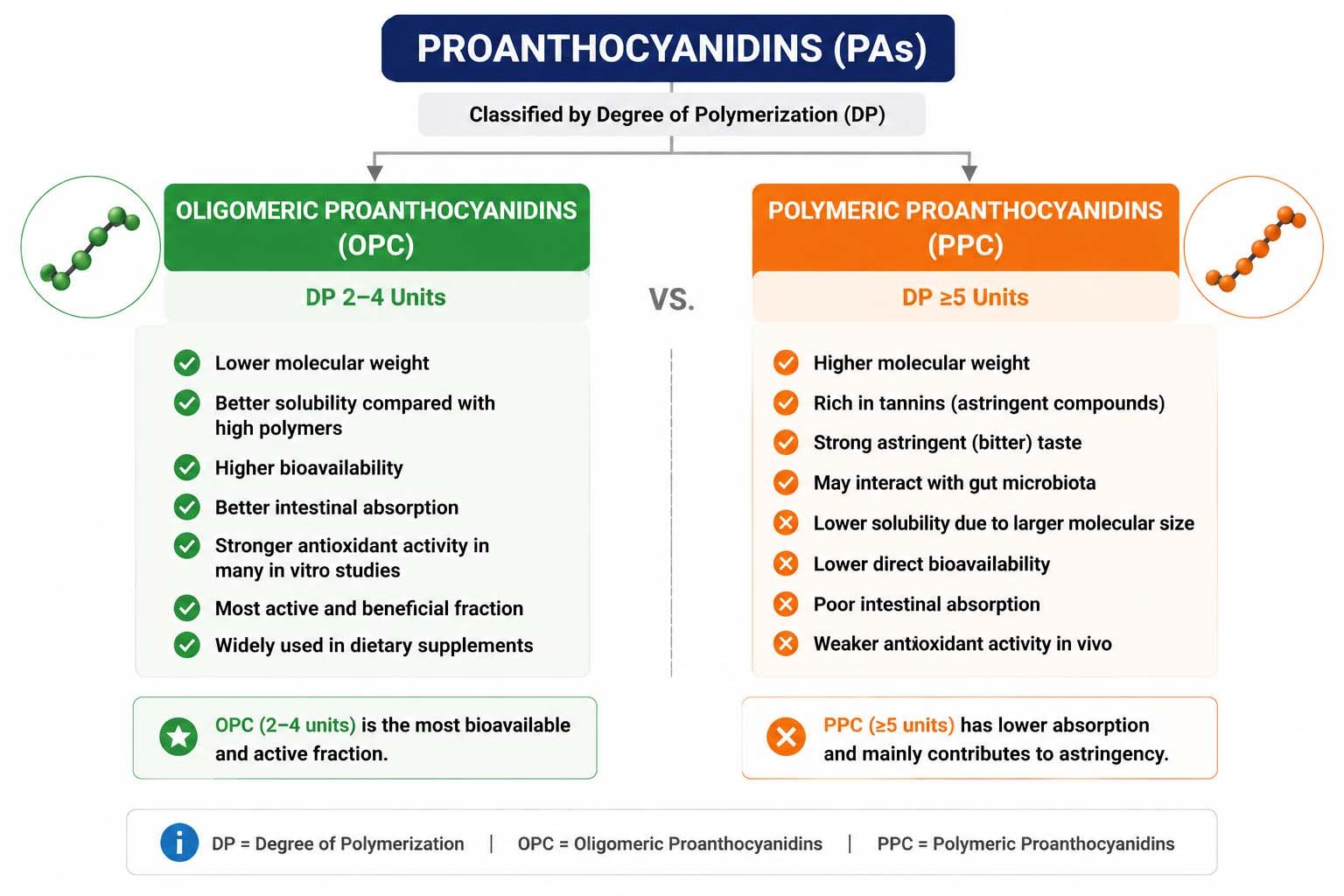
The main difference between OPC and PPC is their molecular size and polymerization degree.
| Type | Degree of Polymerization (DP) | Structure |
| OPC (Oligomeric Proanthocyanidins) | DP 2–4 | Dimers, trimers, tetramers |
| PPC (Polymeric Proanthocyanidins) | DP ≥5 | Pentamers and higher polymers |
Oligomeric Proanthocyanidins (OPC)
The Bioavailable Fraction of Proanthocyanidins
OPC consists mainly of:
- Dimers (DP 2)
- Trimers (DP 3)
- Tetramers (DP 4)
Due to their smaller molecular size, OPCs generally show better absorption characteristics compared with larger proanthocyanidin polymers.
Key Characteristics of OPC
✓ Lower molecular weight
✓ Better solubility compared with high polymers
✓ Higher bioavailability
✓ Better intestinal absorption
✓ Strong antioxidant activity in many in vitro studies
✓ Widely studied in dietary supplement applications
For this reason, many premium grape seed extract products are standardized by OPC content rather than only total polyphenol content.
Polymeric Proanthocyanidins (PPC)
The High-Polymer Fraction of Proanthocyanidins
PPC refers to larger proanthocyanidin molecules containing:
- Five or more flavanol units (DP ≥5)
PPC represents the high-polymer fraction of condensed tannins, which contribute to the astringent taste and mouthfeel of many plant extracts.
Key Characteristics of PPC
✓ Higher molecular weight
✓ Strong tannin characteristics
✓ More pronounced astringent taste
✓ Lower solubility compared with OPC
✓ Lower direct bioavailability due to larger molecular size
Potential Role of PPC
Recent studies suggest that high-polymer proanthocyanidins may interact with the digestive system and gut microbiota, producing different biological effects.
Why Is OPC Considered the Key Active Fraction?
The antioxidant properties of proanthocyanidins are influenced by:
- Chemical structure
- Degree of polymerization
- Bioavailability
OPC vs PPC Comparison
| OPC | PPC | |
| Full Name | Oligomeric Proanthocyanidins | Polymeric Proanthocyanidins |
| DP Value | DP 2–4 | DP ≥5 |
| Molecular Size | Smaller | Larger |
| Bioavailability | Higher | Lower |
| Absorption | Better intestinal absorption | Limited direct absorption |
| Solubility | Better compared with high polymers | Lower due to larger molecular size |
| Antioxidant Research | Extensive studies | Different biological roles |
| Taste | Mild | More astringent |
OPC in Grape Seed Extract
Grape seed extract is one of the most popular sources of natural proanthocyanidins.
Quality Indicators of Grape Seed Extract
When evaluating grape seed extract quality, important indicators include:
- Total polyphenol content
- Total proanthocyanidin content
- OPC percentage
For applications requiring antioxidant performance and higher absorption potential, OPC-rich extracts are generally preferred.
Conclusion
Proanthocyanidins are valuable plant polyphenols with antioxidant properties.
The main difference between OPC and PPC is their degree of polymerization:
- OPC (Oligomeric Proanthocyanidins, DP 2–4) consists of smaller molecules with higher bioavailability and is widely used in dietary supplements.
- PPC (Polymeric Proanthocyanidins, DP ≥5) consists of larger polymers associated with condensed tannin characteristics and lower direct absorption.
Understanding the difference between OPC and PPC helps buyers select the right grape seed extract and botanical antioxidant ingredients for different applications.